
ChatGPT vs Claude (2026): Features, Pricing & Comparison
Artificial intelligence assistants have become essential tools for writing, coding, research, and everyday productivity. Two popular options are ChatGPT by OpenAI and Claude by Anthropic.
But which AI assistant is better in 2026?
In this detailed ChatGPT vs Claude comparison, we’ll explore their key features, writing capabilities, coding performance, research tools, pricing, strengths, and limitations to help you choose the right AI assistant for your needs.
Whether you’re a student, content creator, developer, freelancer, or business owner, this guide will help you understand which tool best fits your workflow.
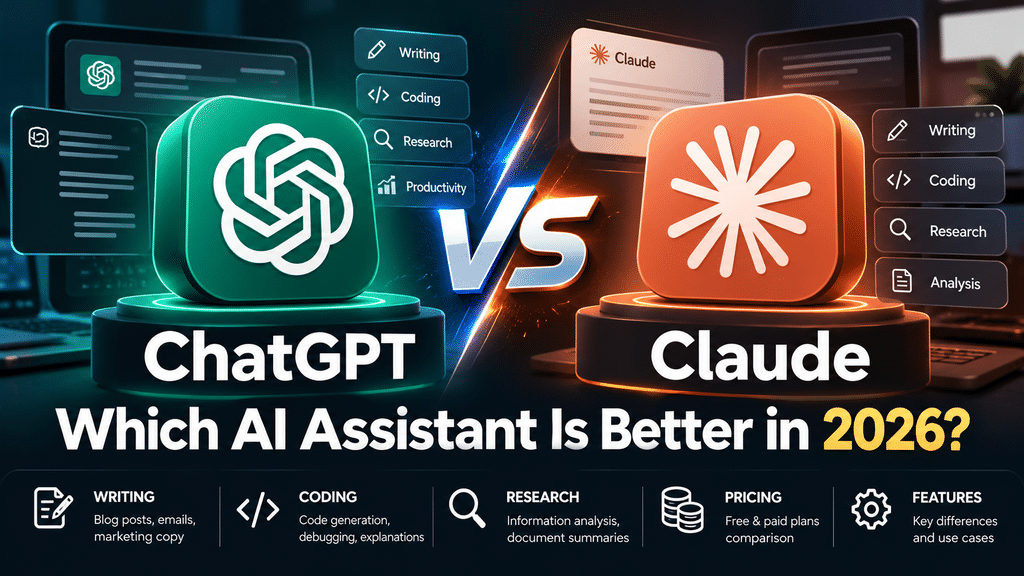
📊 Comparison Table Content
| Feature | ChatGPT | Claude |
|---|---|---|
| Developer | OpenAI | Anthropic |
| Primary Use | General AI assistance | General AI assistance |
| Writing | Drafting, editing, brainstorming | Drafting, editing, brainstorming |
| Coding | Code generation, explanation, debugging | Code generation, explanation, debugging |
| Research | Research and information analysis | Research and information analysis |
| File Analysis | Supported, subject to plan limits | Supported, subject to plan limits |
| Free Access | Available | Available |
| Paid Plans | Available | Available |
Both ChatGPT and Claude offer powerful AI capabilities for writing, coding, research, and productivity. However, their available features, usage limits, integrations, and pricing can differ. The best choice depends on your specific needs and workflow.
ChatGPT vs Claude for Writing
Both ChatGPT and Claude can help users create blog posts, marketing copy, emails, social media captions, and other written content.
ChatGPT for Writing
ChatGPT can assist with brainstorming, outlining, drafting, rewriting, and editing content. Users can request different tones, formats, and writing styles.
It can also help content creators develop article structures, generate headline ideas, and improve readability.
Claude for Writing
Claude can assist with drafting, summarizing, editing, and analyzing written content. It is useful for working with documents, refining explanations, and organizing complex information.
Users can provide detailed instructions to guide the style and structure of the output.
Which Is Better for Writing?
Neither assistant is universally better. For example, a blogger may prefer one assistant’s writing style, while a business user may prefer the other’s document-handling workflow.
The best approach is to test both using the same writing prompt and compare accuracy, clarity, editing effort, and consistency.
ChatGPT vs Claude for Coding
Both assistants support coding-related tasks, including explaining code, generating examples, debugging, and suggesting improvements.
ChatGPT for Coding
ChatGPT can help developers understand programming concepts, troubleshoot errors, write functions, and review code.
Depending on the available tools and subscription, users may have access to additional coding workflows.
Claude for Coding
Claude can help developers analyze code, explain technical problems, generate solutions, and work through software development tasks.
Anthropic also offers Claude-related coding tools for supported development workflows.
Which Is Better for Coding?
Performance depends on the programming language, project complexity, model version, and available tools.
For a fair comparison, test both assistants on the same coding problem and evaluate whether the generated code works, passes tests,
For a fair comparison, test both assistants on the same coding problem and evaluate whether the generated code works, passes tests, follows security best practices, and requires minimal manual correction.
ChatGPT vs Claude for Research
Both ChatGPT and Claude can help users research topics, summarize information, analyze documents, and organize findings.
ChatGPT for Research
ChatGPT offers web search and, on supported plans, deeper research capabilities that can help users investigate topics and work with multiple sources.
It can also assist with comparing information, analyzing uploaded documents, and preparing structured research summaries.
Claude for Research
Claude supports web search and document analysis, making it useful for reviewing lengthy materials, identifying key ideas, and organizing information.
It can also help users explore complex topics and develop research outlines.
Which Is Better for Research?
Both assistants can support research workflows. The best choice depends on the available features, source quality, document requirements, and the level of verification needed.
Neither should be treated as an automatically reliable source. Always check important claims against original references.
ChatGPT vs Claude Pricing in 2026
Both platforms offer free and paid subscription options.
| Plan | ChatGPT | Claude |
|---|---|---|
| Free | Available with usage limits | Available in supported regions |
| Individual paid plan | Plus: $20/month in the US | Pro: $20/month in the US |
| Higher usage plans | Additional paid tiers available | Max plans available |
| Business options | Available | Available |
| API access | Billed separately | Billed separately |
Prices, availability, and usage limits may change. Regional taxes and local pricing may apply.
Is ChatGPT Plus Worth It?
ChatGPT Plus may be useful for users who regularly need advanced reasoning, image generation, file analysis, research tools, and higher usage limits.
Is Claude Pro Worth It?
Claude Pro may be useful for users who need higher usage allowances, longer multi-step workflows, and access to supported Claude coding tools.
Before subscribing, compare the features available in your region and test both free versions.
ChatGPT vs Claude: Which Is Better for Students?
Students can use both assistants for explaining concepts, organizing study notes, brainstorming essay outlines, and understanding difficult topics.
ChatGPT may appeal to students who want a broad collection of learning and productivity tools.
Claude may appeal to students who frequently work with documents and detailed written explanations.
Students should verify information and follow their institution’s academic integrity policies.
ChatGPT vs Claude: Which Is Better for Business?
Businesses can use AI assistants for drafting communications, preparing reports, brainstorming marketing ideas, and analyzing information.
The best option depends on collaboration features, administrative controls, security requirements, integrations, and pricing.
Organizations should review data handling and privacy policies before uploading confidential business information.
Final Verdict: ChatGPT vs Claude in 2026
ChatGPT and Claude are both capable AI assistants, but neither is universally better.
Choose ChatGPT if: You want a broad assistant for writing, coding, image creation, research, and everyday productivity.
Choose Claude if: You prefer its writing and document workflows or want to explore Anthropic’s supported coding and productivity tools.
Our recommendation: Test both assistants with the same real-world tasks before choosing a subscription. Compare accuracy, output quality, speed, ease of use, and total cost.
This comparison is based on documented capabilities rather than independent benchmark testing.
Frequently Asked Questions
1. Is ChatGPT better than Claude?
Neither AI assistant is better for every task. ChatGPT and Claude both support writing, coding, research, and productivity. The better choice depends on your requirements, available features, and preferred workflow.
2. Is Claude free to use?
Yes. Claude offers a free version with usage limits. Paid subscription options provide additional access and capabilities.
3. Can I use ChatGPT and Claude for coding?
Yes. Both assistants can help generate code, explain programming concepts, debug errors, and suggest improvements. Always test AI-generated code before using it in production.
4. Which AI assistant is better for content writing?
Both can help with blog posts, emails, marketing copy, and editing. Try the same writing task in each assistant and compare the results.
5. Can ChatGPT and Claude make mistakes?
Yes. Both can generate inaccurate or misleading information. Verify important facts using reliable sources.
